
AI Sector Analysis
Executive summary
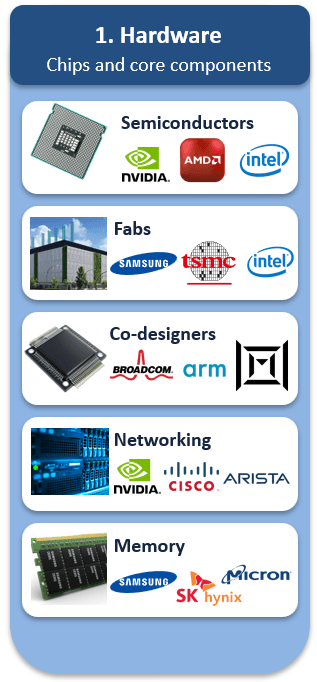
The recent rapid expansion of the artificial intelligence sector has drawn unprecedented investments towards semiconductor manufacturing, data centers, cloud infrastructure, but little attention is drawn towards supporting sectors such as AI center construction and energy infrastructure. The hardware sector alone can be divided further.
Semiconductors, networking equipment, memory chips all have increased in demand in recent years (Bain, 2026). While they genuinely support the infrastructure development, there are concerns regarding the sustainability of projects related to AI data centers. Because demand comes from many companies in the industry, it becomes hard to distinguish actual demand from demand generated by continued investments. Many experts have raised concerns over signs of circular financing in the industry (Bloomberg, 2026). Nvidia, Oracle, Alphabet, and Amazon are invested in multiple facets of the industry at the same time, from chips, to software, to actual datacenter development. Because of this arrangement, the flow of capital may represent a circle in some instances, which exposes the whole value chain to issues related to insufficient revenue collection. AI companies possess sizeable debt and are still relying on constant cash injection.
A large issue with such growth is that it needs to be balanced with demand, but companies are actively accumulating contractual backlogs worth trillions of dollars (Tech-insider, 2026). Balance is important because not meeting demand will give the upper hand to competitors, but to meet RPO (remaining performance obligations) would require further increase in capital expenditure. This will lead to AI companies seeking increasingly bigger funding. Some investors are asking whether expected future revenue is going to be enough to justify such expenses.

Every sector of finance from private credit to funds, banks and venture capital are invested in the AI industry. For many of these, their AI investments make a major part of their portfolios, which means that the whole finance sector is heavily exposed to changes in the AI industry. If AI related revenue falls short of expectations, it will apply pressure across many interconnected industries (Federal Reserve Bank of Chicago, 2026).
Energy access also possess a big constraint when it comes to AI development. Data centers share energy with the surrounding businesses and households, which drives prices up. This has recently been outlined as a serious risk and specialized energy infrastructure including potential nuclear power plants are expected to gradually roll out to support the growing need for electricity. Investment decisions throughout the supply chain are relying heavily on increase in future computing demand.
This draws a possible parallel to the telecommunications boom of the late 1990s. During it, major advancements in Fiber-optic communications, combined with expectations of exponential growth in internet usage, signalled to telecommunications companies to invest heavily in network infrastructure. During the period between 1996 and 2000, the leading industry giants raised around $500 billion through high-yield bonds, bank debt, and convertible bonds (Stern School of Business, 2001).
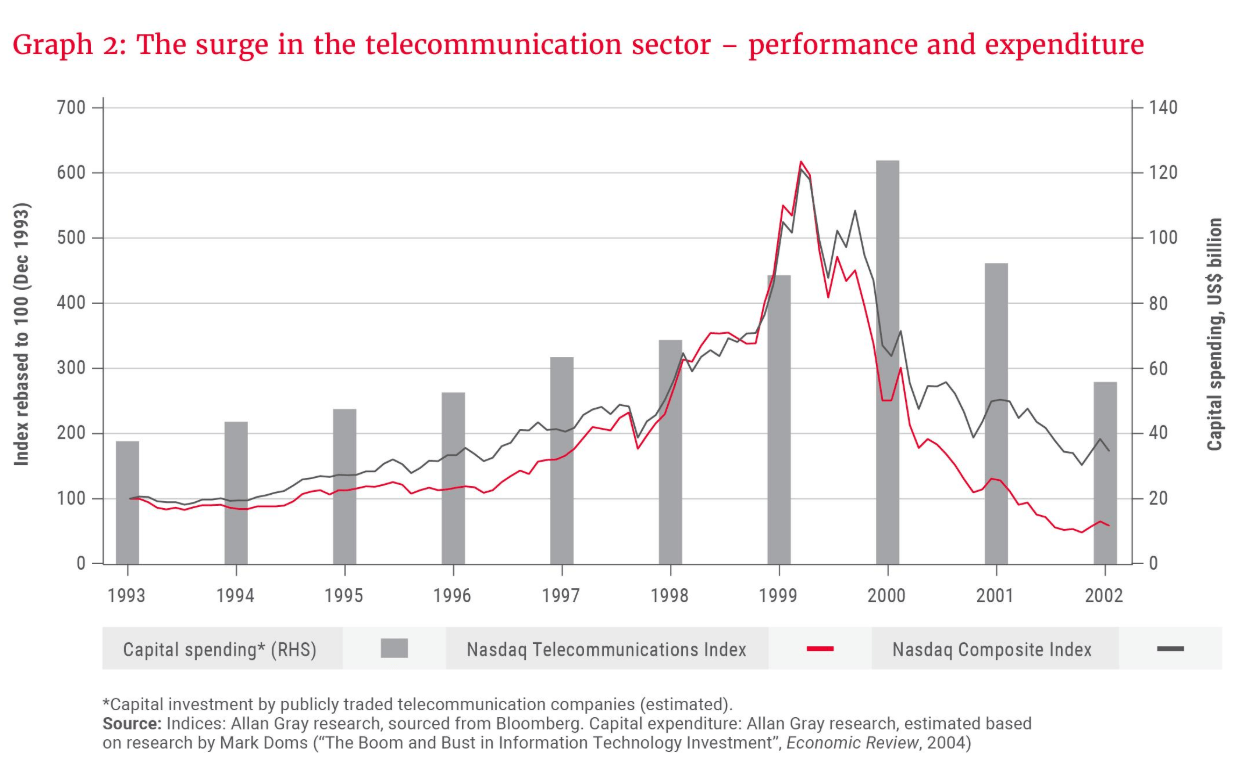
This example is important to research, because many are raising concerns over rising CapEx of AI companies at the time when revenue is not certain to maintain it, yet in the 2000s the exact thing happened with internet infrastructure. CapEx continued rising at the time when the investment thesis has failed. This expansion expenditure was maintained for more than a year before it became clear that the underlying demand is overestimated heavily (Couper et al., 2003).
Artificial intelligence will remain a vital tool in future technological and economic advancement; however, this certainty does not make the current landscape of AI financially stable or a good investment. Financial returns are yet to be proven to be achievable and sustainable, and with multiple factors applying constant pressure, it might not be so. The relationship between infrastructure development, hardware manufacturing, and software advancements will ultimately determine the cost of future expansion and whether it is justified by actual demand.
Investment Flow in AI Sector and Circular Financing
The AI sector is now one of the fastest growing and most capital-intensive parts of the United States economy, though this phenomenon can also be observed worldwide. With such extraordinary growth, some experts are questioning the sustainability of the business and whether there is actually enough demand from the market to justify the scale of expansion of the leading AI “hyperscalers”. This becomes especially concerning when one realizes that a large chunk of this expansion is done through circular financing models. This occurs when companies invest in businesses that use these investments to acquire products or services from the initial investors or their business partners.
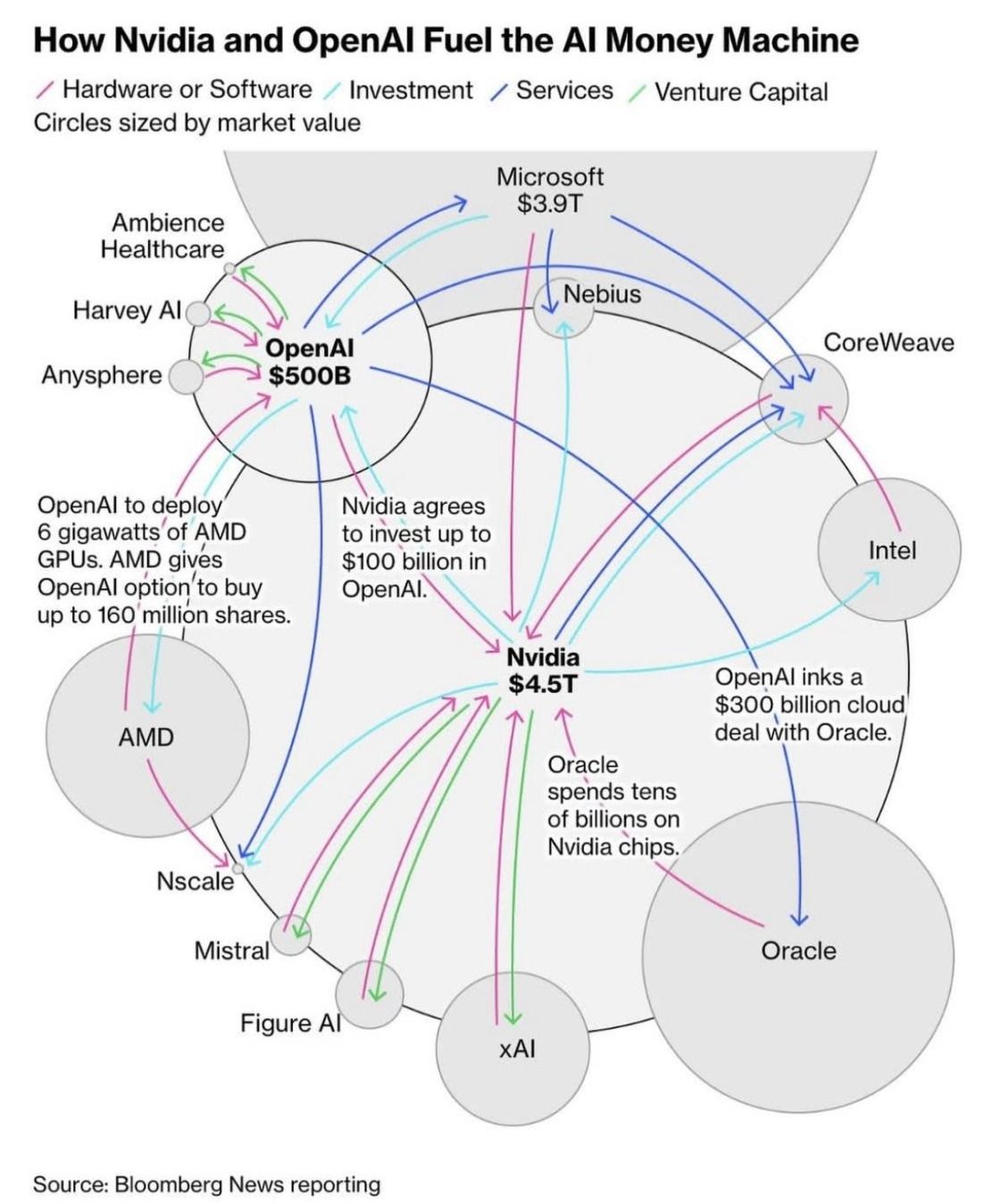
Nvidia is at the forefront of the industry designing and creating hardware needed to train and operate artificial intelligence models. The concerning aspect of its business strategy is that Nvidia also invest in companies that buy its hardware, potentially inflating perceived demand for the technology and skewing company valuations. This phenomenon is not new; however, the scale of this technology expansion is unprecedented.
The industry gets exposed to systemic risks and counterparty interdependence, which leads to true organic market demand remaining ambiguous at the time of significant growth. This is not a one-time occurrence either, multiple companies have been participating in this arrangement. In September 2025, Nvidia revealed their plans to invest up to $100 billion in OpenAI, which was connected with the deployment of “10 gigawatts of Nvidia systems” (Nvidia, 2025). In 2025, Microsoft has extended their multibillion-dollar partnership with OpenAI to continue supplying it with Azure infrastructure (Microsoft, 2025).
It is important to note that circular financing is not inherently fraudulent. These companies are purchasing actual tangible products and are increasing capabilities of their services; however, the actual demand required to pay for these investments may not have been realistically assessed. This may lead to a cycle where constant financing is required to sustain the system as demand will not ultimately be sufficient.
Experts point to similarities during the telecommunications bubble of 2000. At the time, companies such as Lucent and Nortel were financing telecommunications operators who were purchasing their equipment. When aforementioned operators struggled to find funds, orders collapsed and suppliers suffered financial losses and many went out of business (Forbes, 2000).
In addition to this, the demand for AI infrastructure is substantially based on projected future demand, meaning that current investments are largely betting on demand eventually rising to estimated levels. When the whole industry is built around this idea, it becomes clear that there may be more risks associated with related companies than some investors like to admit.
It is still important to note that AI technology is unquestionably transformative and is already changing industries, but just like the internet in the past, it may be revolutionary while at the same time generating weak returns.
Multi-trillion Dollar AI Backlog and the CapEx Problem
Backlog or RPO (remaining performance obligations) represents contracted future revenue that hasn’t been recognized yet. Because the expansion of the AI sector is so aggressive, new contracts are being signed faster than previous ones are being fulfilled and thus RPOs keep accumulating. Sometimes, it may require significant infrastructure expansion to fulfil all the contractual obligations in time. According to company data of the largest cloud infrastructure providers, their combined contractual commitments are worth approximately $2.36 trillion.
Company: Backlog (Period)
Alphabet: $519.5B (June 2026)
Amazon: $496B (June 2026)
Microsoft: $678B (June 2026)
Oracle: $664B (August 2026)
Total: $2.36T
(Source: Alphabet SEC filing, Amazon SEC filing, Microsoft FY2026, Oracle Q1 FY2027)
It is important to note, that these numbers don’t strictly include commitments related to AI activity and each company uses their own accounting definitions; however, this still presents the reality where the growing backlog of obligations is unlikely to be fulfilled without an enormous increase in capital expenditure. Fulfilling these obligations means building data centers, acquiring GPUs, connecting to an electrical grid, and organizing large amounts of water for cooling.
Revenue from RPO cannot be recognized until the contractual obligations are fulfilled, which may create a timing problem for these AI giants. To earn revenue gradually in the future, they need to spend on aggressive expansion heavily right now. If one takes Oracle as an example, in September 2026 it reported $664 billion in RPO, while at the same time reporting quarterly revenue of $19.3 billion, so only around 13% of that backlog was expected to turn into revenue in the following twelve months. At the same time, Oracle has already raised $48 billion in debt and equity and is planning to raise an additional $40 billion in 2027 (Oracle, 2026b).
The problem is that all of these companies need massive capital to receive future returns, while competing with each other and the broader market for the same computing and energy components. Each has to rush to expand in order to fulfil their RPO, as delays risk them losing clients to competition and reduce the value of their future contractual commitments, while reducing revenue.
In the end, revenue needs to justify these expenses, but AI monetization, though rising, hasn’t been proven to bring enough revenue to justify such massive expansion, therefore, current valuations are already betting on this revenue increasing.
The nature of computing equipment like GPUs also works against these companies, as huge warehouses of older cards may start turning uncompetitive because of the performance gaps between the newer and older generations. This in turn puts more time pressure on companies like Alphabet, Microsoft, and Oracle to expand and upgrade. The aforementioned interdependence of companies in the AI sector means that financial pressures will get distributed across the whole industry and may create a cascading effect if one part of the sector struggles.
Some experts argue that the industry has become too financially interconnected to sustain itself, where AI developers sign cloud contracts, which makes cloud providers to invest in infrastructure to fulfil these contracts and chipmakers provide physical equipment while investing in aforementioned AI developers and driving the demand further.
This does not necessarily make the industry a speculative bubble, as demand for the technology and infrastructure assets related to it are real; however, the scale of commitments and the need for massive expansion might put too much pressure on the sector that has so far been balancing on borrowed time. Therefore, it is important to monitor whether actual independent revenue from outside the AI industry grows, how quickly can companies like Alphabet, Microsoft, and Oracle realize their RPO revenue, and whether CapEx can be justified by generated profits.
Artificial Intelligence is here to stay, that is for certain, but the industry may still fail if it does not live up to expectations financially.
Financing - internal bleeding
Everybody has heard about CapEx connected to AI: data centers, infrastructure, energy stations and systems, cloud solutions, capitalized software, R&D and chip factories. All of this costs enormous amounts of money, but where are they coming from? Is it coming from endless pockets of hyperscalers? From banks? From bond market? Maybe the mysterious private credit market?
Sadly, all of these answers are correct and aforementioned sources are a majority, but not the complete list of benefactors of AI. Let’s start with the largest chunk of money; most investment costs are financed by company’s cash. Hyperscalers set the industry standarts and have the strongest cash generating ability, so we will use them as an example. For 1H2026 total CapEx is estimated at ~$300 billion. For a full year of 2025 total CapEx of “Big Four” was $416 billion and for full year of 2024 it was $251 billion. It means, that for 6 months of 2026 hyperscalers have spent 70% of full year CapEx for 2025 and 119% of full year CapEx of 2024. Most of the cash came from their own pocket. That is why, eventhough net income an operational CF is growing rapidly, Free Cash Flow has been dropping and about to turn negative. Almost every single dollar, that these companies make, they spend on investments, most on data centers. It is important to remember, that Free Cash Flow is one of the most important metrics for investors and lenders. CapEx is projected to grow even further, because hyperscalers are planning to build most of components and systems themselves: chips, power management solutions, thermal management solutions, AI models and so on. Unlike even a year ago, they don’t seem to have enough money generating capacity to do that anymore, so the next logical step is to take on more debt. The problem is that the debt market is already filled with AI-connected debt, but this part will be discussed later. Amazon’s Free Cash Flow is already negative and, assuming projections are correct, which is very optimistic, will fall even further. Alphabet’s is projected to stay low, but positive for this year, same with Microsoft and Meta. But then will turn negative in 2027.
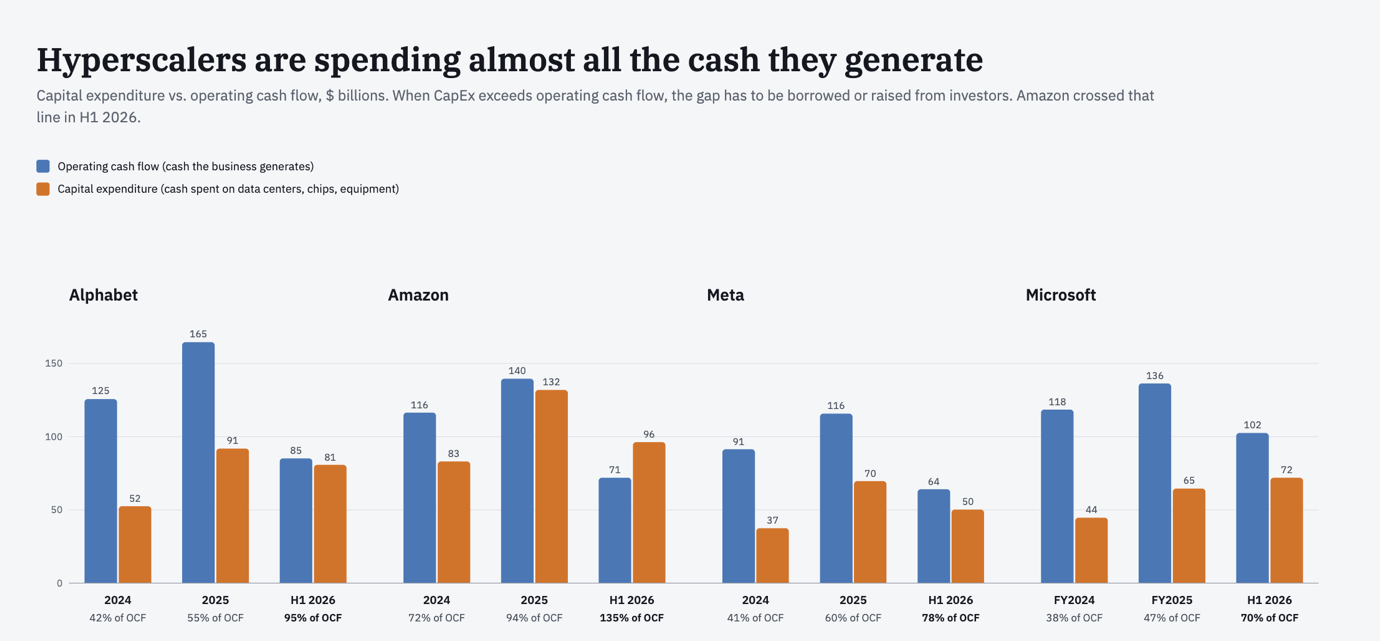
Figure 1, Hyperscalers CapEx in comparison with their cash generating ability
But hyperscalers are just one link in AI supply chain. Chipmakers, like Nvidia and AMD, for example, finance their CapEx with their own money and still manage to pay dividends or arrange buybacks. Grid and power equipment companies do the same, but with one caveat: they use downpayments for future capacities for a build-out. What that means, is that they use money, that customers paid upfront, to finance current spending. It goes without saying, that this breaks basic corporate finance rule of financing long-term assets with long-term liabilities. The strategy of using short-term financing for long-term assets is risky, because it creates maturity mismatch, which means, that money should be returned faster, than asset has time to generate them. But in this case its not the money, that should be returned, but capacities, that those money were spent on. That is even riskier, because building out infrastructure takes time and a lot of things can go wrong. In that case, those companies won’t be able to fulfill their obligations, which means, that they will have to compensate to their client. Makes sense, right? Wrong. In reality, today's supply-constrained market provides grid and power equipment makers with unusual bargaining power. They demand large upfront deposits, cap their liability for delays and pass cost increases on to customers, which are all other participants of the market. Their exposure to penalties is limited, and this leverage reflects the current shortage rather than a permanent feature of the industry. Nevertheless, it passes cost down the supply chain, in case something goes wrong. This pivot from financing was made to show an example of how many things have to go right, for “AI dream” to arrive.
Utilities don’t make enough cash to fully cover their CapEx, which is why industry-wide deficit between Operational Cash Flow and Invesing Cash Flow reached $100+ billion per year. This deficit was financed with bonds and equity issuance. Neoclouds, companies like Nebius and CoreWeave, are a very important part of the chain, because they are the ones, that provide computing power and build data centers, that AI factories and hyperscalers will use in the future and are already using now. They finance majority of their CapEx with debt, because they don’t make nearly enough money to cover spending. Worst part, is that they use not only common debt instruments, like the usual notes, but also off-balance sheet debt, which is the part of financing, that shortly disclosed only in foototes. In line with this information, a logical question arises: if the spending will 100% go up for every member of the supply chain, and will outpace growth, where will the money come from?
The answer, at least partly, is corporate bond market. Hyperscalers have issued around $20 billion in total for full 2024, $109-$121 billion in total for 2025 and around $152 billion in first six months of 2026. It is perfectly visible how hyperscalers don’t have enough of their own resources to finance the build-out. Hyperscalers are only 5 companies. Utilities are the biggest bond issuers in the chain after hyperscalers. They were about 22–25% of US investment-grade issuance so far in 2026, the largest sector by volume. CapEx was over $135 billion in 2025 and is already higher than $100 billion in 2026. Oracle has issued $43 billion of debt in fiscal 2026, Nebius has issued $13 billion up until 3Q2026. AI-related borrowing was about 30% of global corporate bonds issuance in 2025. Sources differ with what is “AI-related borrowing”, but most of them say, that this figure does not contain utilities, so the real number of the whole chain is definetely higher. The indebtedness is displayed in the development of corporate bond yields. Corporate bond spreads, which is the extra yield a company's bond pays above a government bond of the same maturity, have risen in the last two years rapidly. This is mostly true for bonds with longer maturity, so 10 years and above, but it is an inevitable trend for shorter term bonds, because, with this much spending, bond investors are starting to realize, that financial situation of these companies is unsustainable. The worst part, is that there is a trend of issuing 30 and 40 year bonds now, and it happens more often. It means, that conservative buyers, like pension funds and insurance companies, are buying into AI boom, not to mention corporate bond funds and S&P ETF funds, which are not connected to financing in any way, but show, that the whole capital market is now dependent on success of AI build-out.
Then there is equity issuance. Another form of financing, that companies rely on. US venture funding in 1H2026 has reached $412,7 billion, of which $355,9 billion (86%) went to AI. Again, more then for full 2025 (~$318B implied). This financing route is mostly used by AI factories, like Anthropic and OpenAI, which in total raised ~$11,35 billion in 2024, ~$57,5 billion in 2025 and ~$217 billion in 1H2026 through equity issuance. The progression is 342% average growth of this type of financing for these two firms alone. Neoclouds have been doing the same thing. Nebius, at the end of 2024, had equity base of $3,25 billion. Fast forward to June 2026, it has expanded to $10,34 billion. CoreWeave, at the end of 2023, had negative equity base of $-132 million. In June 2026 it reached $5,02 billion. Even Google had to issue a small amount of equity in 2026 (~$45 billion). But equity can’t directly cripple a company like debt can. It can’t lead a company to bankruptsy. The biggest concern for investors is share dilution, right? Wrong again. The biggest danger comes from dependance of these company on equity issuance. If the investors won’t see enough returns and will not invest even more money, company will have to slow down their spending, which will lead to loss of position in the race, which is equal to death in current conditions. Then there is the fact that equity is the most expensive form of capital, because investors expect the highest returns, and, of course, the dilution.
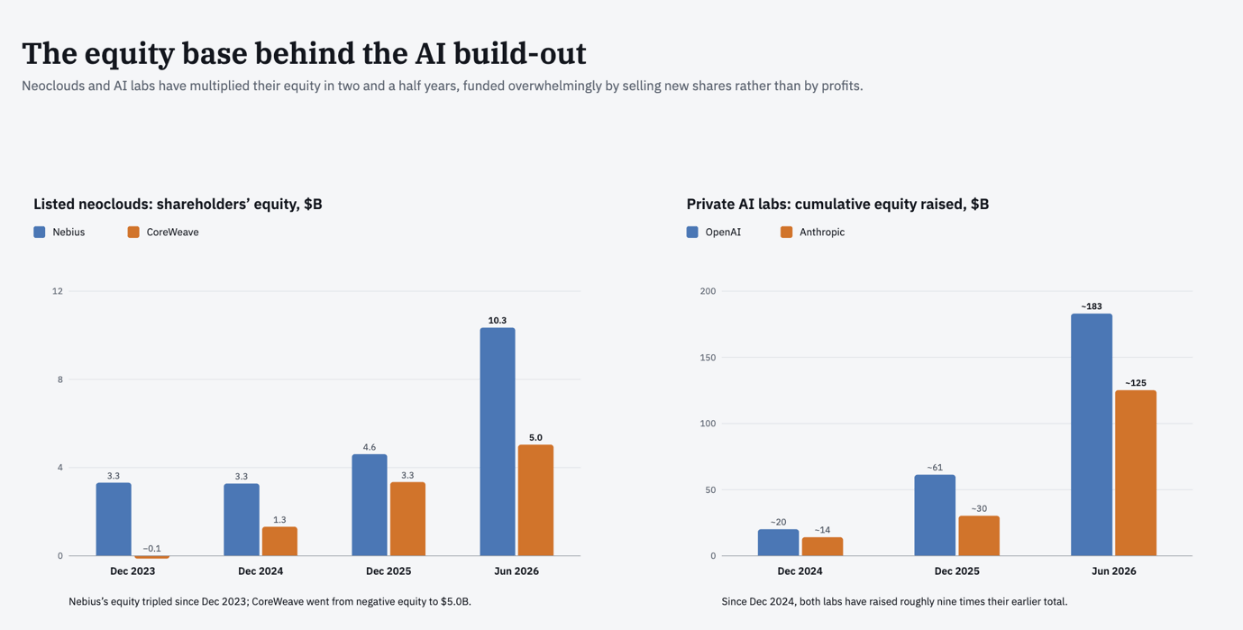
Figure 2, Equity issuance of biggest neoclouds and AI labs
Private credit firms also play a role in the build-out. Primarily, they finance companies, that build data centers, that are then leased to hyperscalers, neoclouds and other participants of the market. Another way private credit funds are involved is chip leases. It’s, basically, the same thing as with data centers: they buy chips and then lease them out to the counterparty that contract was signed with. Then there are also standard loans to companies that, for some reason, are not willing to go to the bank or bond market to receive financing. Companies like neoclouds or other early-stage start-ups don’t generate enough cash to persuade banks and investors to lend them huge amounts of cash, so private credit. This form of financing is more dangerous for a company. It is a lot easier to get a loan from private credit firms than from banks, but it costs a lot more as well. Interest is between 10-15% p.a. in most deals. Another reason why it adds risk to the whole chain is risk concentration: a firm that is already a risky investment (if it wasn’t it would go to the bank or corporate bonds market) adds up even more risk with expensive debt. It is true for data center developers, neoclouds and GPU-leasing vehicles. These businesses are risky enough in itself, because the demand for compute is unpredictable, but adding off-balance sheet debt makes them even riskier.
In the last section I would like to cover bank and private equity exposure, as well as tax breaks. Banks act more as an intermediary. Data center project loans reached about $170 billion in 2025, but banks mostly pass the risk on to bond and private credit investors. That risk returns indirectly: up to half of their total lending to non-bank firms goes to private credit and private equity funds. Private equity also puts in thin slices of equity that unlock large amounts of debt: Blue Owl's ~$3 billion stake in Meta's Hyperion supported $27 billion of borrowing. Tax breaks, such as a 35% federal chip credit and sales tax exemptions in about 32 states, reduce costs rather than fund the build-out, and several states are already scaling them back. The risk is that these layers are interconnected: thin equity, heavy leverage and lenders funding other lenders all rely on the same stream of lease payments from AI labs and neoclouds. If AI revenues disappoint, a shortfall at the top would ripple down through data center owners, private credit funds and banks to utilities, that built capacity for demand that never arrived.
In conclusion of this section, it is important to note, that all of what has been said about financing is the most imporant part of AI puzzle. Demand concerns, Energy price expectations, monetization of the models and other possible problems, all stem from the inability to repay the investments, that were already done and will be done in the future. In case revenues and FCF will dissapoint investors will leave, stock market will crash and a lot of money will be lost, but it won’t be the things, that breaks world. It will be inability to repay debt, that will break the whole chain from ground up.
Price sensitivity and cost of electricity
AI models, data centers, chips, thermal management solutions, clouds and servers. What do all of them have in common? They are all powered by electricity. It’s the electrical capacity, that is the bottleneck of AI build-out, not the CapEx or expected returns. It is one thing that additional financing can’t resolve as fast as the whole supply chain needs it.
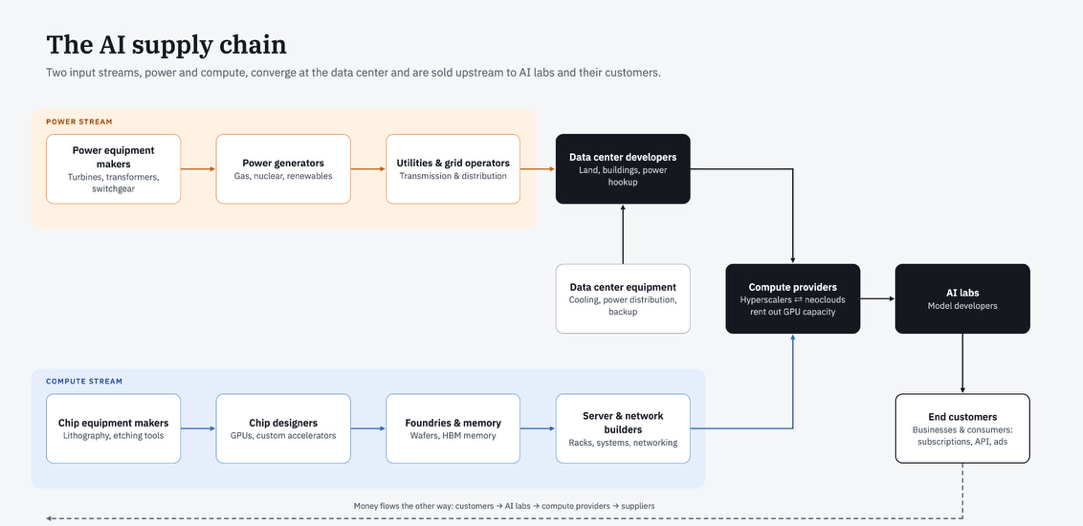
Figure 3, AI supply chain
The biggest data center region in the US is around Virginia. Its grid is run by an organization called PJM, which covers 13 states. PJM holds a yearly auction where power plants get paid simply for promising to be available when demand peaks. The price of that promise exploded:
Year: Price per MW-day
2024/2025: $29
2025/2026: $270 (833% growth)
2026/2027: $329.17 (Limit of allowed price)
2027/2028: $333.44 (Limit of allowed price)
For 2026/2027 the price on the auction hit a sealing of $333, which was set after complaints of Pennsylvania's governor, that consumers were being hit too hard. Both auctions, for 2026/2027 and for 2027/2028 ended exactly at the cap, so the real market price would have been higher. PJM estimates the 2027/28 price would have been about $530 without the limit, around 60% higher. This proves that every part of the chain needs electricity, but the supply of electricity is lacking. Grid interconnection timelines of 36 to 84 months are structurally incompatible with data center build cycles of 12 to 24 months. Building new stations takes time, but they need data centers to work as soon as they are built to generate cash. Price is insignificant to them, because opportunity costs of data centers not working is greater, so they are willing to pay high premiums.
This situation is unsustainable, and we have already seen examples of such bullwhip effect countless times. Each link sees orders rising and, expecting more to come, orders more than it needs and builds extra capacity. Supply cannot rise as fast as demand, because products have to be manufactured, and for that, factories have to be built first. When production ramps up, demand has already levelled off or fallen, and suppliers are left with products and capacity they can't sell.
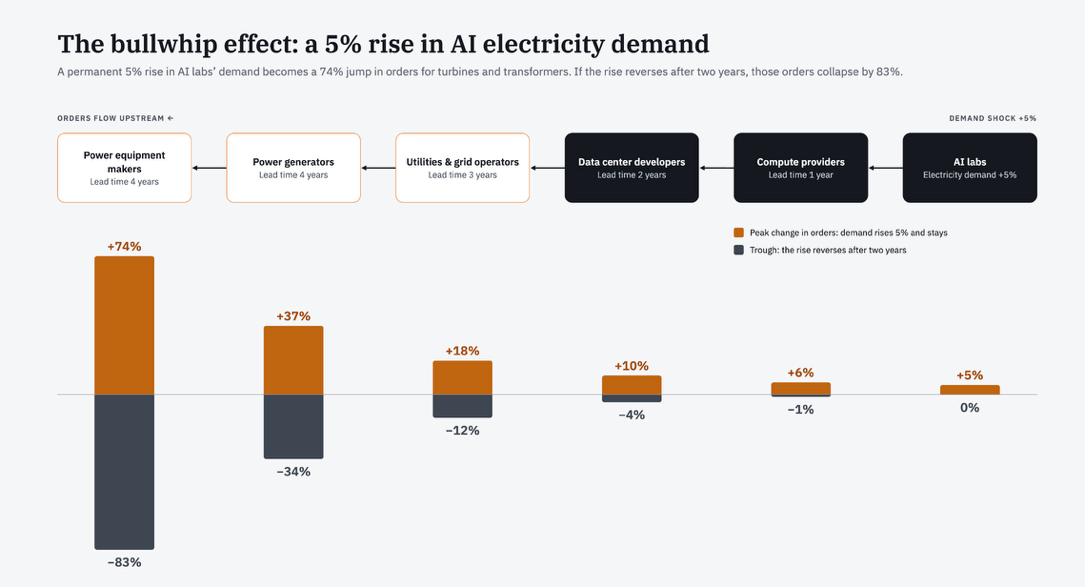
Figure 4, An example of the bullwhip effect if demand for compute temporarily increases by 5%
It happened during COVID, during dotcom bubble, during telecom fiber layout and countless other times. The problem now is that demand is not driven by consumers, but by AI labs, like Anthropic and OpenAI. Imagine a bakery that sells a thousand loaves a day. Owners of that bakery are convinced the town will soon want ten times more bread, so it orders ovens for ten thousand loaves. The mills see the orders and double their capacity, the farmers plant twice the wheat, and the power company builds a new plant to keep the mills running. Yet nobody in town eats more bread than before. The whole chain is responding not to how much bread people actually eat, but to how much the bakery expects to sell. Demand for electricity and chips currently looks almost unlimited. Data center developers and neoclouds keep building because they are confident that AI labs and hyperscalers will lease every megawatt they add, whatever it costs. Yet that demand does not come from consumers. It comes from the labs and hyperscalers themselves, who are building for the usage they expect AI to generate, not for the usage it generates today. They may well be right in the long run, but for now the chain is sized to their expectations, while end customers have yet to show they will use, and pay for, that much AI.
Appendix
References
Alphabet Inc. (2026). Quarterly report for the period ended June 30, 2026 (Form 10-Q). U.S. Securities and Exchange Commission. https://www.sec.gov/Archives/edgar/data/1652044/000165204426000071/goog-20260630.htm
Amazon.com, Inc. (2026). Quarterly report for the period ended June 30, 2026 (Form 10-Q). U.S. Securities and Exchange Commission. https://www.sec.gov/Archives/edgar/data/1018724/000101872426000026/amzn-20260630.htm
Forbes. (2000, May 15). Funny money. https://www.forbes.com/forbes/2000/0515/6511052a.html
Microsoft. (2025, January 21). Microsoft and OpenAI evolve partnership to drive the next phase of AI. https://blogs.microsoft.com/blog/2025/01/21/microsoft-and-openai-evolve-partnership-to-drive-the-next-phase-of-ai/
Microsoft. (2026). FY26 Q4: Investor metrics. Microsoft Investor Relations. https://www.microsoft.com/en-us/investor/earnings/FY-2026-Q4/metrics
NVIDIA. (2025, September 22). OpenAI and NVIDIA announce strategic partnership to deploy 10 gigawatts of NVIDIA systems [Press release]. https://investor.nvidia.com/news/press-release-details/2025/OpenAI-and-NVIDIA-Announce-Strategic-Partnership-to-Deploy-10-Gigawatts-of-NVIDIA-Systems/default.aspx
Oracle Corporation. (2026a, June 10). Oracle announces record Q4 and FY 2026 results driven by cloud infrastructure & cloud applications [Press release, Exhibit 99.1]. U.S. Securities and Exchange Commission. https://www.sec.gov/Archives/edgar/data/1341439/000119312526265848/orcl-ex99_1.htm
Oracle Corporation. (2026b, September 10). Oracle announces Q1 results driven by triple digit growth in cloud infrastructure revenues [Press release]. https://investor.oracle.com/investor-news/news-details/2026/Oracle-Announces-Q1-Results-Driven-by-Triple-Digit-Growth-in-Cloud-Infrastructure-Revenues/default.aspx
Apollo Global Management. (n.d.). Apollo backs $5.4 billion Valor and xAI data center compute infrastructure transaction. https://ir.apollo.com/news-events/press-releases/detail/599/apollo-backs-5-4-billion-valor-and-xai-data-center-compute-infrastructure-transaction-with-3-5-billion-capital-solution
Bank for International Settlements. (n.d.). BIS bulletin no. 120. https://www.bis.org/publ/bisbull120.htm
Bloomberg. (2025, March 31). OpenAI finalizes $40 billion funding at $300 billion valuation. https://www.bloomberg.com/news/articles/2025-03-31/openai-finalizes-40-billion-funding-at-300-billion-valuation
Bloomberg. (2026, February). The $3 trillion AI data center build-out becomes all-consuming for debt markets. EnergyNow. https://energynow.com/2026/02/the-3-trillion-ai-data-center-build-out-becomes-all-consuming-for-debt-markets/
Bloomberg Law. (n.d.). OpenAI valued at $852 billion after closing $122 billion round. https://news.bloomberglaw.com/tech-and-telecom-law/openai-valued-at-852-billion-after-closing-122-billion-round
CRA International. (2025, September). EFLOPS and MWs: The economics behind data center growth. https://media.crai.com/wp-content/uploads/2025/09/09143339/CRA-Insights-EFLOPS-MWs-The-economics-behind-data-center-growth-0925.pdf
CreditSights. (n.d.). Utility credit: Ten themes for 2026. https://know.creditsights.com/utility-credit-ten-themes-for-2026/
DatacenterDynamics. (n.d.). American data center tax exemptions out of control, according to report. https://www.datacenterdynamics.com/en/news/american-data-center-tax-exemptions-out-of-control-according-to-report/
FactSet. (n.d.). Hyperscalers tap external financing as AI capex outruns cash flow. https://insight.factset.com/hyperscalers-tap-external-financing-as-ai-capex-outruns-cash-flow
Federal Deposit Insurance Corporation. (2026, February). Bank lending to nondepository financial institutions. https://www.fdic.gov/analysis/bank-lending-nondepository-financial-institutions.pdf
IESE Insight. (n.d.). AI and the credit market. https://www.iese.edu/insight/articles/ai-credit-market-debt/
Information Technology and Innovation Foundation. (2026, September 22). Congress should make the CHIPS Act's investment tax credit permanent. https://itif.org/publications/2026/09/22/congress-should-make-chips-acts-investment-tax-credit-permanent/
Joint Legislative Audit and Review Commission. (n.d.). Data centers in Virginia. University of Virginia Cooper Center. https://www.coopercenter.org/research/jlarc-report-data-centers-virginia
Lee, H. L., Padmanabhan, V., & Whang, S. (1997). The bullwhip effect in supply chains. Sloan Management Review. https://sloanreview.mit.edu/article/understanding-the-bullwhip-effect-in-supply-chains/
LPL Research. (n.d.). AI's new frontier: The transformation of investment-grade credit. https://www.lpl.com/research/blog/ais-new-frontier-the-transformation-of-investment-grade-credit.html
Mathrani, A. (2026, May 6). The sprint: Data centers are building a parallel energy system in the US. Rabobank. https://www.rabobank.com/knowledge/d011524694-the-sprint-data-centers-are-building-a-parallel-energy-system-in-the-us
Meta. (2025). Meta announces joint venture with funds managed by Blue Owl Capital to develop Hyperion data center. https://investor.atmeta.com/investor-news/press-release-details/2025/Meta-Announces-Joint-Venture-with-Funds-Managed-by-Blue-Owl-Capital-to-Develop-Hyperion-Data-Center/default.aspx
MUFG. (2025, December 19). AI chart weekly: Financing the AI supercycle. https://www.mufgamericas.com/sites/default/files/document/2025-12/AI_Chart_Weekly_12_19_Financing_the_AI_Supercycle.pdf
Neuberger Berman. (n.d.). For utilities, AI poses questions of capacity and affordability. https://www.nb.com/us/insights/article-for-utilities-ai-poses-questions-of-capacity-and-affordability
OpenAI. (2024, October 2). New funding to scale the benefits of AI. https://openai.com/index/scale-the-benefits-of-ai/
Orrick. (2026, February). Anthropic raises $30B Series G at $380B post-money valuation. https://www.orrick.com/en/News/2026/02/Anthropic-Raises-30B-Series-G-at-380B-Post-Money-Valuation
PitchBook & National Venture Capital Association. (2026). PitchBook-NVCA venture monitor: Q2 2026. https://nvca.org/pitchbook-nvca-venture-monitor/
PJM Interconnection. (n.d.). 2025/2026 base residual auction report. https://pjm.com/-/media/markets-ops/rpm/rpm-auction-info/2025-2026/2025-2026-base-residual-auction-report.ashx
PJM Interconnection. (n.d.). 2026/2027 base residual auction report. https://www.pjm.com/-/media/DotCom/markets-ops/rpm/rpm-auction-info/2026-2027/2026-2027-bra-report.pdf
PJM Interconnection. (n.d.). 2027/2028 base residual auction report. https://www.pjm.com/-/media/DotCom/markets-ops/rpm/rpm-auction-info/2027-2028/2027-2028-bra-report.pdf
Platformonomics. (2026, February). Follow the CAPEX: 2025 retrospective. https://platformonomics.com/2026/02/follow-the-capex-2025-retrospective/
Reuters. (2026, July 29). Hyperscaler debt binge pushes yields up as investor demand cools. WDEZ. https://wdez.com/2026/07/29/hyperscaler-debt-binge-pushes-yields-up-as-investor-demand-cools/
Utility Dive. (2025, April). FERC approves PJM capacity auction price cap and floor. https://www.utilitydive.com/news/ferc-pjm-interconnection-capacity-auction-price-cap-collar/745979/
Utility Dive. (2025, December). PJM capacity auction clears at price cap as data center demand grows. https://www.utilitydive.com/news/pjm-interconnection-capacity-auction-data-center/808264/
Wisconsin Watch. (2026, April). Wisconsin data center tax break to cost state more than $2 billion in lost revenue. https://wisconsinwatch.org/2026/04/wisconsin-data-center-tax-break-to-cost-state-more-than-2-billion-lost-revenue/

Radim Dohnal


Capitalinked
Salvátorská 931/8
110 00 Josefov
Napište mi